I am the first person in my extended family to stay at school past age 15. Despite having demonstrated a talent for art, given my early life circumstances, I did not consider art a viable employment option. Instead I pursued a long career in technology, including senior positions in IBM and selling my own software company, which allowed me to retrain and practice as a garden designer.
Whist designing gardens I also attended part-time courses and weekly studio practice in portrait and life drawing, first at Putney School of Art then at the Cheyne Drawing Studio based at the London Sketch Club. During this time, I exhibited at both venues and sold some of my life drawings at the Daggart Gallery, Notting Hill. I also experimented with professional digital photography using the iPhone, taking several part-time courses at Kensington & Chelsea College where a selection of my photographs were exhibited. These experiences kindled my desire to undertake a third career as an artist. I decided to join an art school where utilising my technology background, I could explore the intersection of art and technology. That led to my two-year practice led research MA in Fine Art Digital at UAL Camberwell School of Art and my recent staff appointment as a visiting practitioner. I now focus on storytelling, exploring a mixture of traditional art and the latest technologies.
My ability to add new knowledge in a practice led research PhD is evidenced by:
A Distinction in my MA. Transcripts include “Overall, your progress on the course has been incredible…Evidence of analysis which potentially contributes new ideas, processes or knowledge to the field or is ground breaking in a way that would be recognised as valid by experts in the field”.
Technical research for my PhD building on a long and deep experience in computer technology. Whilst waiting to start a PhD, my research has continued informally. I have exhibited at Tate Modern for Tate Exchange in 2017 and 2018, http://www.tate.org.uk/visit/tate-modern/tate-exchange and at Tate Lates March 2018.
Regular attendance of the monthly Augmented Reality Forum held at UCL and other events including VR World and Lumen Prize.
Membership of EVA London (Electronic Visualisation and the Arts) and Volumetric Filmmakers NYCU.
Consistent visits to art galleries and museums, including Venice Biennale 2017, and the Rijksmuseum and Van Gogh Museum Amsterdam in 2018. I am a friend of RA and Tate.My wife is a member of the Museums Association, and a volunteer in the Theatre and Performance archives of the V&A.
My own home office with advanced facilities including equipment for 3D scanning, volumetric filmmaking, virtual and mixed reality, binaural audio recording, IoT and photography.
My art practice is concerned with immersive storytelling and current social issues.
I use Mixed Reality (a form of VR allowing 3D virtual objects to be combined with my physical art installations) and binaural audio in order to increase empathic response from the audience. Physical art installations consist of digitally fabricated sculpture set amongst a video background projected on all surrounding walls. Visitors first see this, then use either headphones (with inbuilt audio players) or a Mixed Reality visor, currently the Microsoft HoloLens to experience added layers to the work. These devices allow the user to freely walk around the installation while experiencing actors performing alongside huge-scale 3D replicas of the sculptures, both appearing as part of the physical installation.
I have entered my art installation ‘The Refugees’ Crisis’ for the Aesthetica Art Prize 2018, which if successful would be exhibited in Spring 2019.
Academic and practice based research for my PhD at Kingston University
I plan to submit two papers to EVA London 2019, the first based on my MA research paper concerned with issues relating to the conservation of digital art, and the second a short introduction to my PhD research.
I will investigate the possibility of working with Kingston University Centre for Augmented and Virtual Reality (CAVE), a facility of the Faculty of Science, Engineering and Computing. In particular, I would like to set up a pilot for Volumetric Filmmaking using my own equipment, which if successful KU may wish to expand this to a full capability. This is part of my planned PhD practice based research as it is a portable facility to volumetrically record both static art (paintings and sculpture), as well as movement (art installations and performance) in a museum and art institution setting. This will contribute to an archive that will enable recorded art to be viewed as though it were physically present in a real world environment using Mixed Reality glasses, a glasses free holographic display, or AR projection mapping. Artworks in the collections of other institutions that have been captured in 3D could also be brought into this archive, and viewed in the same way.
I maintained a WordPress Blog for my MA, which I am continuing for my PhD. This can be viewed at www.terencemquinn.com .
I have already established a file of my PhD research on Evernote, with currently over 1300 items including research papers, articles, and books. I can provide access to all or part of this record to my PhD Supervisors if requested. I am in the process of building a detailed Mind Map for my PhD which can also be shared and discussed in order to agree an appropriate programme of research.
Making the Absent Object Present: Towards a holographic Museum of Modern Art (hMoMA)
Practice Led Research: How artworks can be recorded and viewed in Mixed Reality to enable a holographic Museum of Modern Art (hMoMA).
Mixed Reality (MR) devices now allow 3D 360-degree holograms to appear physically present in the real world. Such devices enable a person to view and walk around a hologram as they would the original, but in their own home or educational environment. Although not the same as viewing the original, the MR hologram provides an alternative experience to the viewer that is very close to reality. My investigations will determine which categories of artwork can be recorded and viewed effectively in MR, and how this may be achieved in a museum or art institution setting.
The primary aim of this research is to enable art institutions to display, in a single gallery space, any recorded object in their collections, or from past temporary exhibitions. This will include artworks otherwise hidden from public view, such as the vast collections now in storage due to limited gallery space, or which are too fragile for public display, or which cannot be conserved for the long-term, such as digital art.
This research will therefore make important contributions to new knowledge for creating a holographic Museum of Modern Art. If implemented, hMoMA will enable present and future generations to experience more of their cultural heritage than is otherwise possible.
Proof of Concept
Delft University in Holland use MR to enhance the visitor experience of a Rijksmuseum exhibit (Maltha, 2016).
“Scan the World is an ambitious initiative whose mission is to archive the world’s sculptures, statues, artworks and any other objects of cultural significance using 3D scanning technologies to produce content suitable for 3D printing”. The British Museum and Tate are contributors to this initiative which currently provides open on-line access to 3D scans of almost 9000 sculptures (MyMiniFactory, 2014).
My research so far, extends these ideas and illustrates some first steps towards achieving hMoMA.
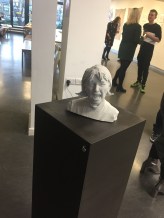
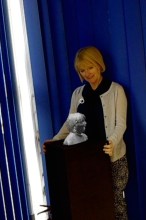
In April 2017, I took part in demonstrating to V&A academics my exhibit Making the absent object present. Wearing a Microsoft HoloLens headset, participants walked around a hologram of my 3D sculpture, displayed in exactly the same place as the removed original (also shown at Tate Exchange: Tate Modern, Kingston University and The Museum of Futures, London).
The original sculpture The holographic sculpture
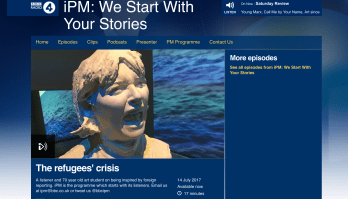
In July 2017, my MA show exhibit The Refugees’ Crisis allowed participants to freely walk around several oversize holographic images as an integral part of a physical art installation, while listening to a binaural recorded narrative. This was the subject of a BBC Radio 4 iPM programme (BBC Radio4 iPM, 2017).
In February 2018, I spoke and exhibited this again at St. Hugh’s College, Oxford University.
The Refugees’ Crisis
Ravensbourne University HoloPortal lab, which is supported by Microsoft and a research organisation (DoubleMe, n.d), have offered the possibility for me to volumetrically re-record the short film in this installation. It will enable the speaking, moving characters to be seen in MR as though they were physically present in my exhibit. However, I first plan to set up and test my own portable Volumetric Filmmaking facility using six RealSense D415 depth sensing cameras, and Realsense SDK.
My PhD builds upon my MA research paper Digital to physical – made to last? Will functioning digital art be part of our future cultural heritage? (Quinn, 2016) which examined the issues involved with the conservation of digital art in the context of our future cultural legacy. Digital art in particular is transitory as most will eventually be lost forever due to decay or technical obsolescence.
The technologies used are expected to develop considerably over the timescale of a PhD, which will give me the opportunity to significantly extend my enquiry. This fast paced development is evidenced by a plethora of recent and expected announcements in the field of Virtual and Mixed Reality from Microsoft, Apple, Google, ODG, Meta and many other advanced technology companies worldwide.
Original Contribution to Knowledge
Most research in the area of VR/ MR is not directed towards artistic endeavor, but to commercial opportunity particularly for gaming or business application.
My research would provide the following contributions to new knowledge, as hMoMA will:
Make the absent object present and allow users to experience recorded artworks in a way that is very close to seeing the original.
Make an important new contribution towards providing a record of important artworks for our future cultural legacy.
Provide an additional advanced form of archival documentation.
Offer an alternative to conventional digital art conservation.
My research questions and provisional timetable
Year 1
What types of artwork can be captured to be viewed holographically? By what means? At what quality? To what extent is the authenticity of the original preserved in the outcome? Painting, sculpture, performance art, born-digital art, interactive art and exhibitions all have different requirements.
How can artworks be captured in their established setting? Artworks exhibited in a museum, in storage or outside have different demands.
How can captured artworks be experienced in various settings and by what means? In a museum? At home?
What is the reaction to hMoMA by all stakeholders? Artists, curators, the general public, lawyers, academics?
What will incentivise stakeholders to actively support or promote hMoMA in their organisation? To overcome potential resistance to change.
What other potential barriers exist to hMoMA, including cost and copyright law?
What other contributing developments and research exists in other universities and institutions?
Finalise my PhD practice based research proposal.
Year 2
What version(s) of hMoMA can be implemented now? Demonstrate what can be achieved using my own artwork(s).
Approach the V&A and Tate with a view to a research collaboration. Agree to develop metrics to judge results of an hMoMA prototype using an art installation in their collection. This will provide the basis for reflection and critical analysis of the project.
How does the practical implementation of hMoMA perform against agreed metrics? Carry out an external demonstration using both my own artwork and that of a collaborating institution.
What further research and development is needed? Determine how limitations and barriers to hMoMA might be overcome, and provide direction for further research, including what is needed for volume implementation.
Year 3/4
Publish results as my PhD practice based dissertation.
Organise, or participate in, a public exhibition showing the best of what can be achieved with hMoMa.
Amathys 3D. (2014) Augmented Reality Geneva Art & Museum History Museum Achille et Penthésilée Corps et Esprits. Available at: https://www.youtube.com/watch?v=i0nL8gWblBM [Accessed: 12 October 2017].
Appleyard, B. (2017) The V&A’s History Man: Meet the new boss Tristram Hunt. London, UK. Sunday Times.
Cameron, F. and Kenderdine, S. (eds.) (2010) Theorising Digital Cultural Heritage: A Critical Discourse. Massachusetts, USA. The MIT Press.
Cameron, F. (2007) ‘Beyond the Cult of the Replicant: Museums and Historical Digital Objects – Traditional Concerns, New Discourses’ in Cameron, F. and Kenderdine, S. (eds.) Theorising Digital Cultural Heritage – A Critical Discourse. Massachusetts, USA. The MIT Press.
Cloonan, M. V. (ed.) (2013) Preserving our heritage. Perspectives from antiquity to the digital age. Chicago, USA. American Library Association.
Hazan, S. (2007) ‘A Crisis of Authority: New Lamps for Old’ in Cameron, F. and Kenderdine, S. (eds.) Theorising Digital Cultural Heritage – A Critical Discourse. Massachusetts, USA. The MIT Press.
Kipman, A. (TED 2016) A Futuristic Vision of the age of holograms. Available at:
Lo, R. (2016) Microsoft Hololens Newest Competitor: Meta 2 (and it might be even better). Available at: https://www.youtube.com/watch?v=jHHa1BNCDcA [Accessed: 20 January 2017]
Rinehart, R. and Ippolito, J. (2014) Re-collection: Art, New Media, and Social Memory. Massachusetts, USA. The MIT Press.
Serexhe, B. (ed.) (2013) Digital art conservation.Preservation of digital art: Theory and practice. Germany. Ambra V and ZKM Centre for Art and Media.
Uzadi, S. (2016) Holoportation: Virtual 3D teleportation in real-time (Microsoft Research) Available at: https://www.youtube.com/watch?v=7d59O6cfaM0 [Accessed: 26 June 2016].
Witcomb, A. (2007) ‘The Materiality of Virtual Technologies: A New Approach to Thinking about the Impact of Multimedia in Museums’ in Cameron, F. and Kenderdine, S. (eds.) Theorising Digital Cultural Heritage – A Critical Discourse. Massachusetts, USA. The MIT Press.
 terencemquinn91